Gwenlake Atlas
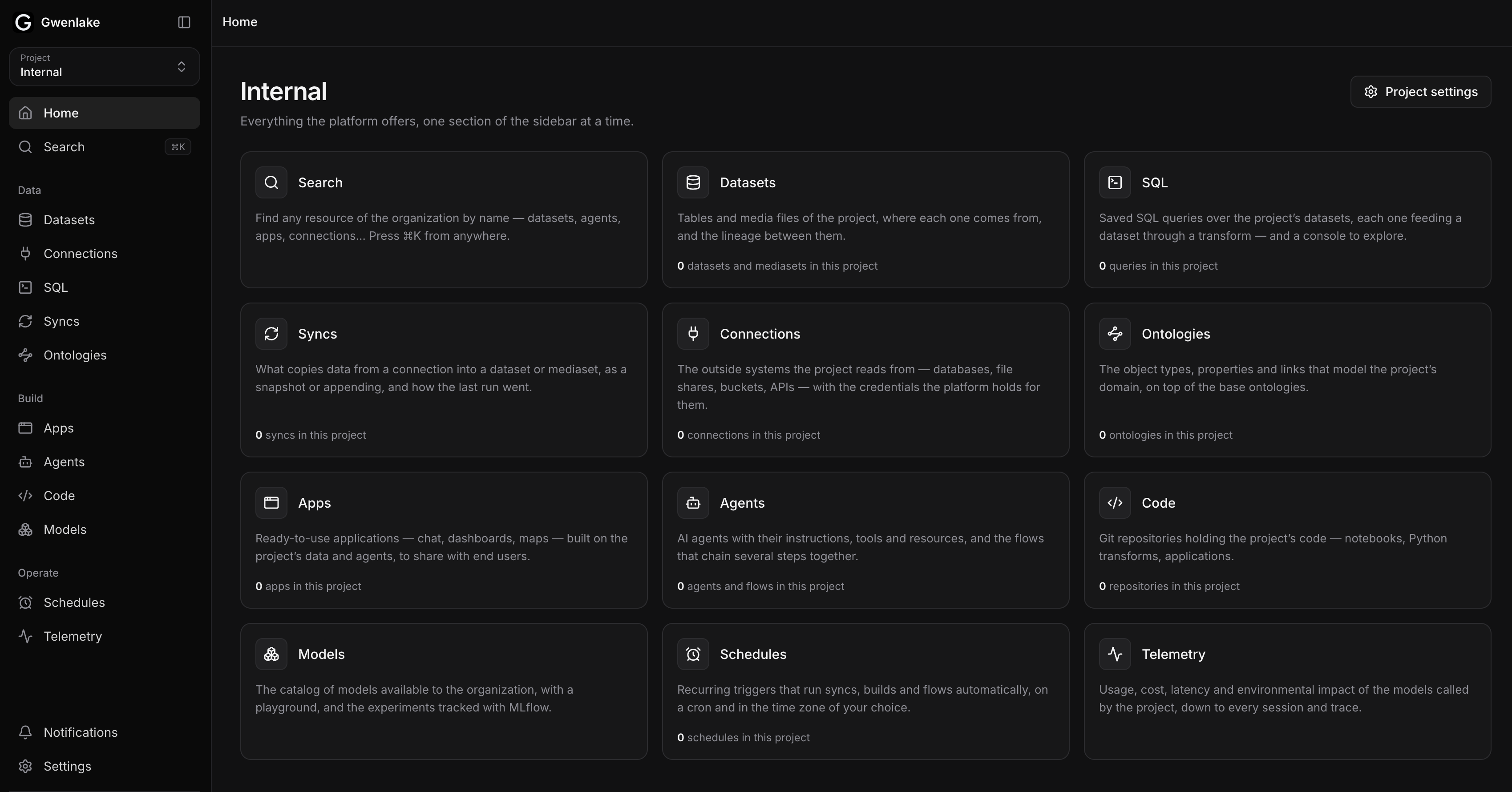
Atlas connects to your business systems, prepares your data using your ontology and full lineage, runs your models and agents, and writes the results back into the tools your teams already use. All inside an environment you control.
Gwenlake Atlas, the platform that gets your AI projects to production faster.
Connect & Read
Around twenty connector types (CRM, document stores, mailboxes, databases, object storage, git, any REST API), with credentials held in a dedicated service.
Transform
OCR, chunking, embedding, vectorisation and joins across sources, with provenance carried on every row down to the source file and page.
Ontology
Concepts and relations derived from your data, so models and agents read your vocabulary rather than column names.
Models & Agents
Send the prepared material to the models we build for you, or to Gwenflow agentic pipelines, schedule them, watch every run.
Connect & Write
Outputs pushed into Salesforce, Dynamics 365, Power BI, Tableau or your own applications, through the same connections Atlas read from or through your APIs.
Every row knows where it came from.
Atlas records the provenance of every row: the file, the page, each transformation it went through. Lineage says where the data came from, the ontology what it means, and a system that has both can be checked, corrected and trusted.
- validateschema customer_360 v3 · 0 errors
- joinerp.orders ⋈ crm.contacts on customer_id
- deduplicate2 records → 1
- normalisename · country ISO 3166 · currency EUR
- sourcecrm.contacts #88213 · invoice_2024-03.pdf, page 4
Every kind of data, prepared the same way.
Atlas recognises what it is given and processes it automatically: tables are typed and joined, time series aligned, documents read and chunked, audio and video transcribed. Everything lands in the same datasets, with the same lineage.
- Tabularschema · types · joins
- Time seriesresampling · alignment · gaps
- DocumentsOCR · chunking · embedding
- Audiotranscription · speakers · timestamps
- Videoframes · transcription · scenes
Ontologies. From column names to business concepts
Here is a simplified version of the ESG ontology we run on Atlas. This is the part a model needs in order to know that an emissions figure belongs to a factory, which belongs to a company, and was verified by an auditor.
Who
What is disclosed
Who checks
Who
- Organization operates Site
- Organization covers ESG topic
- Site reports Metric
- Person owns Target
What is disclosed
- Metric measures ESG topic
- Metric tracks Target
Who checks
- Framework defines ESG topic
- Assurance verifies Metric
- Regulator requires Target
With your ontology, agents reason over your concepts.
An agent is only as reliable as what it knows about your business. The ontology tells it which concepts exist, how they relate and which actions it may take on each, so it stops guessing over column names and works from your vocabulary, inside your rules.
QuestionWhich suppliers missed their 2025 emissions target?
- scans 214 tables, guesses tbl_sup.em_val
- assumes em_val is in tonnes
- finds no target, invents one
“Three suppliers missed their target, led by Nordlicht at +18%.”
Unverifiable- Supplier → operates → Site → measures → Metric (CO₂e, t)
- Metric → tracks → Target 2025
- action compare_to_target · read-only
“Two suppliers missed their target: Nordlicht at +6% and Lumen at +2%.”
Traced to source- Fewer hallucinationsThe agent can only name concepts and relations that exist, and every figure it cites traces back to a row and its source.
- Concepts it understandsDefinitions, units and synonyms are written once: CO₂e, Scope 1 or net zero mean the same thing to every agent and every team.
- Actions it is allowedEach object declares what can be done with it and by whom: read, propose, or execute after approval. The agent cannot act outside them.
- Checks before answersAn auditor agent validates each plan against the ontology’s constraints, and sends it back when it does not hold.
Monitor usage with telemetry
Atlas records what each run did and what it cost: by user, by project and by application, traced through OpenTelemetry to any OTLP backend. Not so you get a bill you did not expect, but so you can see where the usage goes and decide what is worth running.
- Sessionsper user and project
- Tracesone per run
- Spanssteps inside a trace
- Latencyseconds, per run
- Tokensprompt and completion
- Est. costper model, per run
- CO₂egrams, per session
- Error rate% of runs
Run it where your data lives
The same platform, three ways to run it. Pick the one your security team is comfortable with; you can move between them later.
- Fastest to start
Fully Managed
Hosted and operated by us on sovereign European infrastructure. You get a ready platform; we handle updates, monitoring and support. - Your perimeter
On your cloud
Deployed in your own cloud account, on the sovereign or public cloud you already use. Your keys, your network; we install it and keep it running with you. - Full control
On-premise
Installed on your own servers, air-gapped if required. For data that cannot leave the building.
See Atlas running
We will walk you through the platform on a live demo: the connection, the preparation, the model, and the answer landing back in a business tool. Then we can talk about what your own case would take.